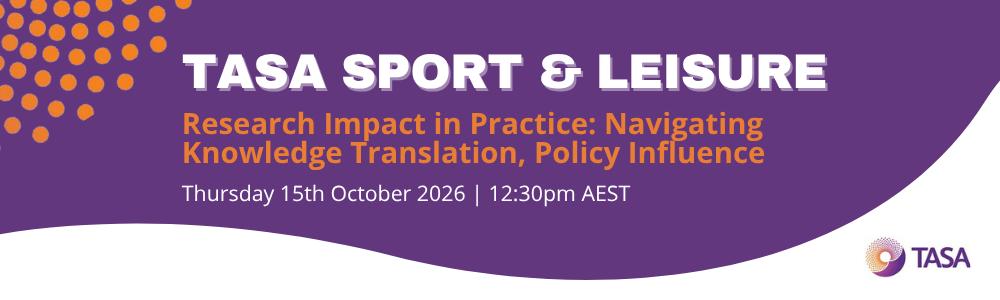
Universities increasingly place emphasis on research impact through promotion frameworks, funding schemes, institutional strategies, and government accountability measures. While impact is often presented as a linear process of translating evidence into outcomes, researchers frequently encounter complex barriers, competing stakeholder interests, and uncertain pathways to change.
This seminar explores how researchers can navigate these challenges while remaining strategic, authentic, and purposeful in their engagement activities.
Using three guiding questions, the seminar examines some of the key challenges and opportunities associated with generating research impact. First, what does meaningful research impact look like beyond academic publications? Drawing on examples from gender equity, violence prevention, and sport policy research, the seminar considers how research can shape policy, practice, public discourse, and organisational decision-making. Second, how can researchers plan for and demonstrate impact throughout the research process?
The discussion explores the role of knowledge translation, relationship building, and engagement strategies in creating pathways for research to travel beyond academia. Finally, how can research be translated to influence policymakers, practitioners, communities, and other stakeholders? Particular attention is given to the politics of impact, competing stakeholder interests, and the difficulties associated with tracing how research is interpreted, adapted, and used in different contexts.
Through practical examples and discussion, participants will explore strategies for identifying meaningful pathways to impact, building productive relationships with stakeholders, and developing evidence of impact that can support grants, promotion applications, and future research opportunities.
The seminar aims to provide researchers with practical approaches for creating intentional and sustainable impact while critically reflecting on the opportunities and limitations of contemporary impact agendas.
Event Details:
Date: Thursday 15th October 2026
Time: 12:30pm - 13:30pm (AEST)
Format: Zoom Webinar
Webinar
Cost: complimentary
Your Speakers

Ramon Spaaij
Ramón Spaaij investigates complex social problems, developing solutions that create and sustain thriving communities as Professor of Sociology in the Institute for Health and Sport at Victoria University. The arc of his career has been a sociological investigation of how thriving and inclusive communities can be created and sustained, and how social inequalities can be transformed. He has made major contributions to scientific knowledge at the intersections of social justice, inclusion, equity, and sport. He has pioneered participatory and ethnographic research that centres the lived experiences of culturally and racially minoritised communities in sport and amplifies their voices in academic, policy, and public conversations. Ramón is also an international expert on terrorism and lone actors. His research supports the prevention of violent extremism through sport and culture. The Applied Security Science Partnership, which he co-founded, investigates disengagement from violent extremism to support participants to live fulfilling lives in nonviolent ways. Ramón partners with organisations global to local, building relationships to understand key problems practitioners and communities face to develop capacity-building resources changemakers can deliver with confidence.

Mary Woessner
A/Prof Mary Woessner is an ARC DECRA Fellow within the Institute for Health and Sport (IHES) at VU. She leads the Safe and Inclusive Sport Research group, with embedded research programs on gender based violence, child safeguarding and history and gender justice in sport. She values mixed methods and co-design approaches to research that focus on human-centred outcomes. Her research team is committed to implementing trauma informed practices in how we engage in our research and with each other. She has completed training in Trauma Informed Care and Psychological Safety.
She is passionate about contributing to evidence-based decision making and developing innovative solutions for complex societal challenges. Dr. Woessner's research focuses on understanding and improving how communities engage with and deliver community sport in ways that are safe, inclusive, and supportive of mental and physical well-being. In her teaching, Dr. Woessner prioritises the student experience and continuously seek to innovate our approach, encouraging my sessional staff and team members to integrate real-world scenarios into their practice.
She is a co-founder of the International Research Network on Violence and Integrity in Sport, and recently co-chaired the Research Pre-Congress Symposium at the first International Congress on Safe Sport Research.
Ruth Jeanes
Ruth is Professor and Deputy Dean Research within the Faculty of Education. Ruth is a sociologist whose research interests focus on the use of sport and active recreation as a community development and educational resource, particularly to address social exclusion amongst minoritised populations.
Ruth's research has attracted a range of external funding. She is lead investigator on a recently awarded ARC Linkage grant 'Informal sport as a health and social resources amongst diverse young people' ($250,000) with co-investigators Dr Justen O' Connor, Professor Dawn Penney and Professor Ramon Spaaij and in partnership with VicHealth, Centre for Multicultural Youth, Cricket Victoria and the Department of local governernment, sport and cultural industries. This study builds on a recently completed project also funded by the ARC Linkage scheme ($200,000) for a project 'Participation versus performance: Managing (dis) ability, gender and cultural diversity in Junior Sport'. The grant team was led by Professor Ramon Spaaij from Victoria University.
Methodologically Ruth seeks to give voice to disempowered individuals and communities within her research by drawing on a range of participatory approaches developed from her PhD. Ruth's PhD thesis utilised feminist post-structuralism to examine the role of sport and specifically soccer in the construction of girls' gender identities and she has developed this area to research and continues to publish on how constructions of gender and sport can facilitate and constrain girls' involvement in sport.
More recently, Ruth's research has examined the role of sport in assisting young homeless men to connect with support services, to support identity (re) construction amongst men experiencing mental illness, and the ways in which newly arrived and refugee committees use sport when settling in Australia. Ruth has an ongoing interest in examining the experiences of young people with disabilities in sport and leisure contexts. Internationally she has undertaken extensive research work in Zambia, examining the role of sport in HIV/AIDS education as a tool to empower young women and as means to foster hope and a sense of community amongst both men and women living in highly impoverished urban compounds.
Simone Fullagar
Simone is an interdisciplinary sociologist who has published widely on gender equity in sport, mental health, active communities and social well-being. With an interest in social and organisational change her work contributes to thinking differently about inequalities. Simone also has a professional background in community service management for diverse populations. In 2014 she moved from Australia to the University of Bath, UK, to lead the Physical Culture, Sport & Health research group. In July 2019 she returned to Griffith University as Professor of Sport Management to lead the strategic focus on gender equity in sport. She is Chair of the Sport and Gender Equity research hub https://www.griffith.edu.au/griffith-business-school/departments/tourism-sport-hotel-management/sage-at-griffith. She is also an active member of the Griffith Centre for Social and Cultural Research and Inclusive Futures: Reimagining Disability beacon.
Simone has received funding from the Australian Research Council and other programs to conduct qualitative research into leisure, sport and health related areas. For example, addressing the gender gap in disability sport, violence prevention and response in sport, gender equity in mega sport event legacy planning, women’s recovery from depression, the socio-cultural context of youth suicide in rural and urban communities and equine programs for at risk youth. She has also undertaken research on the challenges to active family lifestyles, critical obesity and the emergence of the slow travel movement. With colleagues she has published on the rise of new women's sports such as roller derby, the importance of gender inclusion in cycling tour events and the inclusive potential of parkrun. Her recent books include Feminist Futures for Sport: Tracing the Affective Dynamics of Gender Equity in Sport Organisations (Pavlidis, Fullagar & O'Brien, 2025, Palgrave) and Feminism and a Vital Politics of Depression and Recovery (Fullagar, O'Brien & Pavlidis, 2019, Palgrave).
Simone is a past President of the Australian and New Zealand Association for Leisure Studies. In 2015, she was the first Australian to receive the Shaw-Mannell International Leisure Research Award for her contribution to feminist scholarship in leisure, sport and health from the University of Waterloo, CA. In 2019, Simone was appointed as a fellow of the Academy of Social Sciences, UK.