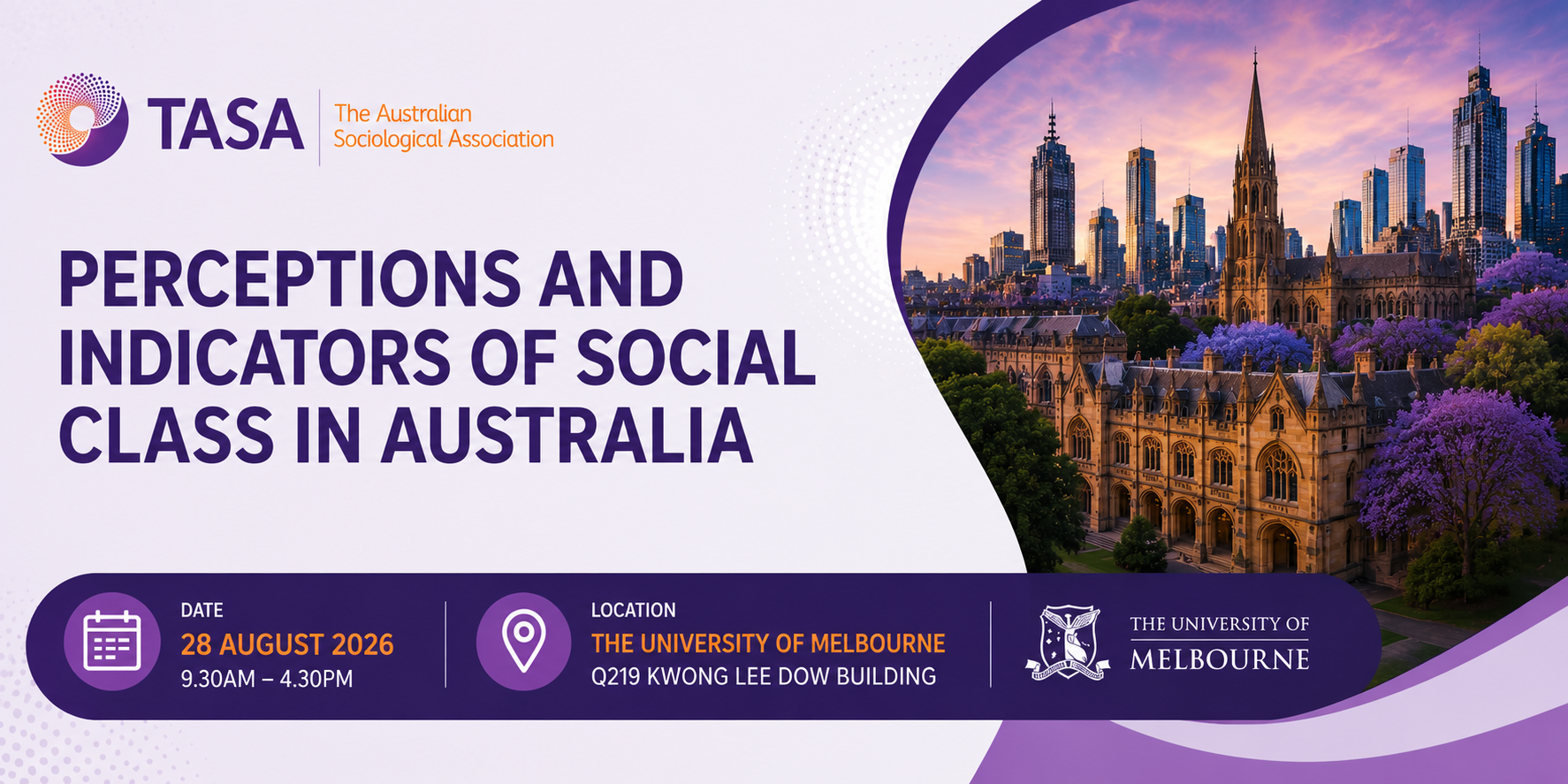
Due to the generous support of TASA, the Social Stratification Thematic Group will be convening a one-day Symposium in Melbourne on 28 August 2026.
The theme of the Symposium is "
Perceptions and Indicators of Social Class in Australia."
The re-emergence of social class as a key topic in Sociology signifies a renewed interest in how society structures opportunities that facilitate access to education, income, wealth, housing, healthcare and so on. Sociologists examining social stratification may employ quantitative methods to define and estimate objective measures of social class. For example, measures of income and wealth, measures of levels of education and occupational prestige; measures of deprivation and poverty.
Sociologists examining social stratification using qualitative methods may interview participants about their perceptions of social class. For example, asking participants about the relevance of social class, about their perceptions of indicators of social class, or about their understanding of how society structures opportunities available to people according to their family background.
Decades of research have recognised the importance of family background for how young people access opportunities for education, however, there is now an emerging awareness of how family background impacts other spheres of life including housing and healthcare. For example, the growing reliance on the ‘bank of mum and dad’ for accessing the property market indicates that inequalities are deepening.
The Symposium has three core aims:
[1] to provide opportunities for Graduate Researchers and Early Career Researchers to present work-in-progress papers in a supportive environment and receive feedback from senior scholars in the field of social stratification;
[2] to contribute to debates about social inequalities in Australia; and
[3] to generate collaborations.
EVENT DETAILS
Date: Friday 28th August 2026
Time: 9:30am - 4:30pm
Location: Q219 Kwong Lee Dow Building, University of Melbourne
Cost:
In-person Ticket - Free
Online Ticket - Free
* Morning & afternoon tea provided. Lunch at own expense
YOUR SPEAKERS
Emeritus Professor Mark Western
Mark Western's various roles at The University of Queensland included Senior Lecturer to Professor in Sociology, co-Director of The University of Queensland Social Research Centre (2003-2008), Founding Director of the Institute for Social Science Research (ISSR, 2009 - 2022), Research Director for The Queensland Commitment (2023 - 2025) and Director of HASS Research Infrastructure (2025). As Founding Director of ISSR, Mark led Australia's largest multidisciplinary social science research institute with a track record of advanced academic social science research and high impact research and policy engagement with government, industry and the not-for-profit sector. As Research Director for The Queensland Commitment, Mark contributed to the design and implementation of The Queensland Commitment at UQ, and its supporting research and evaluation program.
Mark has a personal research program that spans academic publishing across sociology and cognate social science disciplines. He has also led and contributed to major research and evaluation programs and projects for external government and non-government partners. He is a former Chief Investigator on the ARC Centre of Excellence for Policing and Security and the ARC Centre of Excellence for Children and Families Over the Life Course.
Mark is a current member of the National Research Infrastructure (NRI) Advisory Group, advising the Australian government on NRI policy and strategy, a Fellow of the Academy of Social Sciences, Chair of the Academy's Policy Committee, and a member of its Board of Directors. He is a former member of the ARC College of Experts, ERA Chair, and Engagement and Impact Deputy Chair.
He has edited and authored 7 books, and over 120 book chapters, journal articles and commissioned reports and held research grants and contracts worth approximately $120 million.
Steven Threadgold
Steven Threadgold is Associate Professor of Sociology at University of Newcastle. His research focuses on youth and class, with particular interests in unequal and alternate work and career trajectories, underground and independent creative scenes, and cultural formations of taste. Steve is Co-Director of the Newcastle Youth Studies Network, an Associate Editor of Journal of Youth Studies, and on the editorial boards of The Sociological Review and Journal of Applied Youth Studies. His books include Class in Australia and Bourdieu and Affect: Towards a Theory of Affective Affinities. Youth, Class and Everyday Struggles won the 2020 Raewyn Connell Prize for best first book in Australian sociology.
Andrew Leigh
Andrew Leigh is the Assistant Minister for Productivity, Competition, Charities and Treasury, and Federal Member for Fenner in the ACT. Prior to being elected in 2010, Andrew was a professor of economics at the Australian National University. He holds a PhD in Public Policy from Harvard, having graduated from the University of Sydney with first class honours in Arts and Law. Andrew is a past recipient of the Economic Society of Australia's Young Economist Award and a Fellow of the Australian Academy of Social Sciences.
His books include Disconnected (2010), Battlers and Billionaires: The Story of Inequality in Australia (2013), The Economics of Just About Everything (2014), The Luck of Politics (2015), Choosing Openness: Why Global Engagement is Best for Australia (2017), Randomistas: How Radical Researchers Changed Our World (2018), Innovation + Equality: How to Create a Future That Is More Star Trek Than Terminator (with Joshua Gans) (2019), Reconnected: A Community Builder's Handbook (with Nick Terrell) (2020), What's the Worst That Could Happen? Existential Risk and Extreme Politics (2021), Fair Game: Lessons From Sport for a Fairer Society and a Stronger Economy (2022), The Shortest History of Economics (2024), Battlers and Billionaires: The Updated Story of Inequality in Australia (2024) and The Shortest History of Innovation (2026).
For further information, please contact A/Prof Jenny Chesters:
jenny.chesters@unimelb.edu.au