Journal of Sociology acknowledges the Wurundjeri Woi Wurrung people of the Kulin Nation as the Traditional Owners of the lands on which our editorial work is undertaken in Naarm. We recognise the continuing connections of Aboriginal and Torres Strait Islander Peoples to Country, waters, skies and communities across Australia, and pay our respects to Elders past and present. We also recognise the importance of Indigenous knowledges and scholarship to the study of society. |
We are delighted to introduce the latest Special Issue of JoS, ‘Towards a Pedagogy of Care in Higher-Ed Institutions', guest edited by Siddhi Bhandari and Riddhi Bhandari. A sociologist and anthropologist respectively, the Bhandari sisters have brought together scholars from India and beyond to shape a new concept, 'pedagogy of care', which offers a critical lens on how higher education institutions instrumentalise the work of care. It is a concept that resonates all too easily across the globe where academic staff's genuine care for students becomes an uncounted, yet ballooning part of daily workloads. Teachers are expected to offer extra-curricula enrichment, pastoral care, and endless availability out of class hours, all to boost lucrative 'student experience' metrics. The burden of this work often falls unevenly across staff and often exacerbates existing inequalities. As the guest editors add, it often precludes any care for staff other than as care-givers.
As such, this Special Issue tackles a crucial issue that sits at the heart of our work as sociologists. It opens a rich and critical conversation about how a 'pedagogy of care' operates, how it spirals into our labours, and how we might wrest back genuine notions of care in what we do and what we need as educators, scholars, and colleagues. The insights of the papers are sobering but also incisive and galvanising, so we do hope you can carve some precious time out from your own 'pedagogy of care' work to read it.
As a separate offering, this issue also launches the new Teaching Notes section. This new format for JoS invites shorter research and reflective articles on what it means to teach sociology and to teach sociologically. Teaching Notes is edited by Garrity Hill and Nick Pendergrast. You can learn more about this new format by reading their first editorial as well as two Teaching Notes in this issue. One Teaching Note explores student mobility programs, while the other focuses on resistance through crip embodiment.
We hope you enjoy the issue!
Signe Ravn and Ashley Barnwell
Editors-in-Chief
| 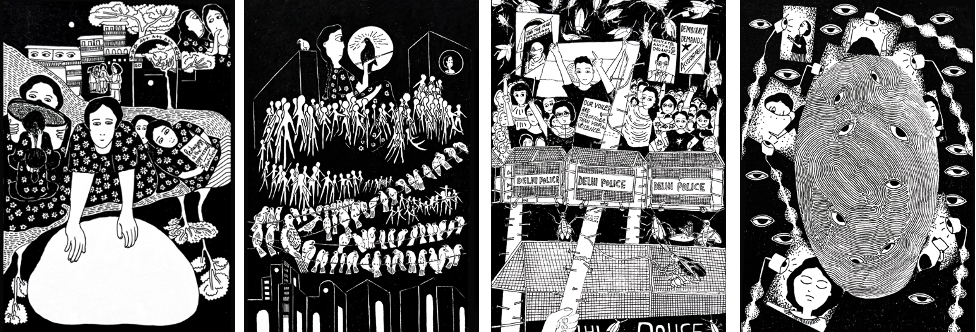 | Figure 1. Solidarity as Care, ink on paper 2026.
Figure 2. Recognition as Care, ink on paper 2026.
Figure 3. Care as Work, ink on paper 2026.
Figure 4. The Absurdity of Surveillance, ink on paper 2026.
We are pleased to share artwork by Alaka Kavallur that accompanies the Special Issue. You can read the artist's statement here. | A sneak peak inside the latest Special Issue: |
Editorial: Towards a Pedagogy of Care
Riddhi Bhandari and Siddhi Bhandari
Across the globe, universities and the state of academia have become common topics in news media. Journalists are tracking how politics and economics are making and re-making student-led activism and the universities’ response to it; interrogating the role of the university in shaping citizens and workers; critiquing the university as a place of work and learning, and charting the tensions that these confluences produce. These issues and debates, for us, centre around pedagogy and care, and comprise the praxis and affect that are crucial to teaching and learning, and that are traditionally thought to be embodied in higher-ed institutions.
Read the full article here |  | | Image by Maulana Ahmad via Unsplash
Teaching Sociology and Invoking Sociological Imagination in Neoliberal Times: Possibilities and Predicaments in New Contexts
Sriti Ganguly and Ashwin Varghese
This paper draws from the authors’ experiences of teaching sociology and social anthropology in academic institutions in India and the possibilities and predicaments they entail. Cultivating the sociological imagination has been at the heart of pedagogical practices in social anthropology; however, in the new, neoliberalized and privatized higher education spaces, invoking this link between individual and society is increasingly becoming challenging thus making the authors contemplate whether the preconditions for teaching critical sociology and sociological imagination are diminishing. With sociology's relevance for employability often called into question, sociologists in such spaces find themselves conflicted between caring for the students, their need for more skill-based sociology, and caring for the discipline's fundamental critical approach that forces individuals to encounter uncomfortable truths of inequality, marginality, oppression, privilege, and domination. The paper argues that alterity and diversity are fundamental and necessary preconditions to both cultivating a sociological imagination and a pedagogy of care that elicits values of solidarity, empathy and the collective.
Read the full article here |  | | Illustration by Masantocreative on Unsplash
‘How Much Care is Too Much Care?’ Towards a Critical Pedagogy of Care in Higher Education
Pranta Patnaik
Teaching as care work requires exploring the intersections of care, emotions, and ethics. Educators often navigate personal vulnerability, balancing ethical responsibilities and emotional labour. This article raises three central questions: How does care manifest in classroom teaching? What negotiations occur in treating teaching as care work? Moreover, how do care and ethics intersect? Using Tronto's five phases of care – caring about, caring for, care giving, care receiving, and caring with – the study adopts a methodology closely aligned with Bourdieu's idea of ‘scientific reflexivity’ and Sparkes’ notion of auto-ethnographic writing. Drawing on over two decades of teaching experience across different educational institutions, the article examines the complexities of teaching theoretical courses in a neoliberal context, where market-driven, skills-based curricula dominate. Students increasingly choose practical subjects aligned with industry demands, reflecting the neoliberal care agenda’s shaping of educational policy and institutional goals. A self-reflexive pedagogy is essential to critically engage with the challenges and possibilities of care.
Read the full article here |  | | Photo by Imagine Buddy on Unsplash
Masterclass in Ethnography: Towards a Pedagogy of Care
Siddhi Bhandari
Masterclass, comprising a special short duration session, has historically been associated with performing arts. It has become an important mode of instruction in colleges that specialize in inter-disciplinary or skill-based and industry-facing education that aim to equip students with a range of practical and professional skills, and research tools. In this article, I draw on my experience of teaching in an art and design higher education college, to deliberate and build on the idea of pedagogy of care that lies at the juncture of teaching ethnography as a masterclass. In this direction of design pedagogy, the masterclass format which necessitates familiarity with skills, especially research methods that are rooted in the social sciences and humanities, has become a mainstay. How do ethnography and masterclass come together to inform design research? How can pedagogy of care be understood at the intersection of ethnography and design? Situating pedagogy of care in the ethics of ethnographic research, I argue that it is at the intersection of the triad of teaching, learning, and researching, where the notion of care for all three is articulated and addressed.
Read the full article here |  | | Photo by Jakub Żerdzicki on Unsplash
Can Pedagogy of Care be Practiced in Precarity? Lived Experiences of Contractualization of Academic Labor from India
Rituparna Patgiri
Contractualization of academic labor has been a dominant feature of Higher Education Institutions in India in recent times. This has been evident in how ad-hocism—a form of contractualization—has operated in the University of Delhi. The neoliberal push towards universities’ self-managing their funds is fundamental in making academic labor precarious. They are expected to operate as corporations focused on skill development, event management, and producing market-ready workforces rather than sites of critical thinking. As such, faculty well-being and security often take a back seat, with casualization seen as a cheaper solution. In this paper, I ask the question: Is it realistically possible to practice a pedagogy of care in structural systems where contractualization of academic labor is a norm? Should contractual teachers be expected to teach with care in uncaring educational institutions that are hostile to them? Using a combination of qualitative research methods, including auto-ethnography, lived experiences and in-depth interviews, I illustrate how the pedagogy of care framework is insufficient to understand the teaching−learning system when structural discriminations such as contractual academic labor exist. The structural discriminations are manifested in the hierarchy and inequality in the workplace, and the lack of academic freedom in the classroom. I argue that contractualization is antithetical to the very idea of what has been called a pedagogy of care.
Read the full article here |  | | Illustration by Alghozy on Unsplash
From Pedagogy of Pain to Pedagogy of Care: Interpreting the Discursive Shift
Gowhar Fazili
This paper traces a discursive shift in South Asian educational discourse from a pedagogy of pain—grounded in discipline, punishment, and emotional repression—to a pedagogy of care, framed increasingly through empathy, affect, and relationality. Drawing on personal narratives and theoretical insights from Foucault, hooks, Freire, Noddings, and Tronto, it argues that these pedagogical models are shaped by broader structures of power. While traditions of care and pain have historically coexisted, the contemporary emphasis on care must be seen in light of neoliberal appropriations that redefine it as emotional labor, personal responsibility, and a means of institutional control. Through a sociological lens, this paper examines how both pain and care function as technologies of power—either reinforcing conformity or fostering critical consciousness, depending on their deployment. Ultimately, it argues that care retains radical potential, though this is increasingly constrained by its commodification and depoliticization in neoliberal regimes.
Read the full article here |  | | Photo by Herbert Goetsch on Unsplash
Technologies of Disempowerment: Digitalisation, Academic Labour and the Pedagogy of Care in South African and UK Universities
Mariya Ivancheva
This paper explores the effect of the digitalisation of higher education on the transformation of academic labour and the pedagogy of care. Drawing on 17 focus groups involving 53 academics across South African and UK universities, the study asks how digital technologies introduced in the name of widening access and pedagogical innovation are experienced by academics in their everyday life within two distinct university systems. The paper identifies three key contradictions that digitalisation brings into sharp focus within faculty experience: marketisation vs scarcity; democratisation vs alienation; and workload intensification vs disempowerment. It demonstrates how within a market-driven university landscape marked by structural inequalities and resource asymmetries, digital technologies increasingly intensify these contradictions. While often presented as neutral tools for enhancing access and efficiency, they are experienced by academics as technologies of disempowerment that reorganise academic labour and constrain the responsive, reciprocal, and relational pillars of the pedagogy of care.
Read the full article here |  | | Library of Congress, Prints & Photographs Division, Farm Security Administration/Office of War Information Black-and-White Negatives.
Mommy, Mammy, Maid: Black Feminist Pedagogy and Challenges to Care.
Rachel Cantave
This article draws from first-hand experience to explore the unique challenges Black women faculty face as more colleges in the United States prioritize care for students over other forms, methods, and recipients of care. To consider some potential avenues for engaging a holistic Black feminist pedagogy of care, this article reflects on the pressures that Black women faculty negotiate in relation to expectations of care in racist and sexist societies, and their academic institutions. Divided into three stereotypical tropes—mommy, mammy, and maid—or what Black feminist scholar Collins calls “controlling images,” each section identifies and explores the sexist and racist implications of care as they relate to Black women faculty in American higher education. This article concludes by providing some preliminary thoughts on how a pedagogy of care might be reimagined to address the interdependent needs of students and faculty.
Read the full article here |  | | Photo by Patrick Tomasso on Unsplash
Careless Universities and a Pedagogy of Care
Liz Dean
If a pedagogy of care is to care about students’ learning, academics often bridge the gap between students’ multiple expectations of tertiary education and institutional demands. The article explores how tertiary funding distributions result in narrowing higher education's potential through subject and staff loss. It suggests that when universities focus on job-ready approaches to learning, they can appear to care less about students’ learning to critically question the present and reimagine possible futures. This article provides an account of three overlapping ways in which universities are becoming and have become careless. First, it considers the recent erosion of the Arts to show, second, how this manifests as the contraction of staff and critical knowledges and third, unsustainable expanding workloads for academic staff. The article concludes by situating a pedagogy of care as an ethical commitment to student learning, and a form of resistance to the instrumentalising higher education.
Read the full article here | 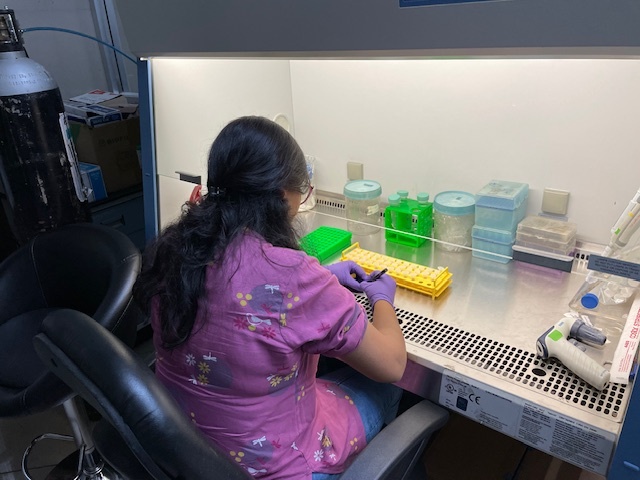 | | Photo supplied by Kritika Katyayan
Bridging the Gender Gap: Women in STEM-related Higher Education in India
Kritika Katyayan, Saikat Maitra and Manish K. Thakur
This paper explores the gendered structures of care, time, and institutional culture, as they shape women's participation in science, technology, engineering, and mathematics (STEM) education and employment pathways in India. Drawing on semi-structured interviews with female STEM graduates, professionals and academics between 2021 and 2023, it analyses how care responsibilities, time poverty, and patriarchal norms interact to constrain women's ability to engage fully in paid work, education, and personal care. While existing public policy frameworks in India focus on skilling and inclusion, they do not recognise the emotional, social, and structural contexts that shape women's experiences and their ability to learn and work. The paper extends the care framework by combining feminist ethics of care with institutional practice, mentoring, and structural design. It argues for a comprehensive reorientation of India's STEM education ecosystem by positioning care, relational empathy, and support structures in the educational and economic opportunities.
Read the full article here |
Crisis and Promise in the Contemporary University by Raewyn Connell
Reviewed by Mahuya Bandyopadhyay
Read the full review here | | | 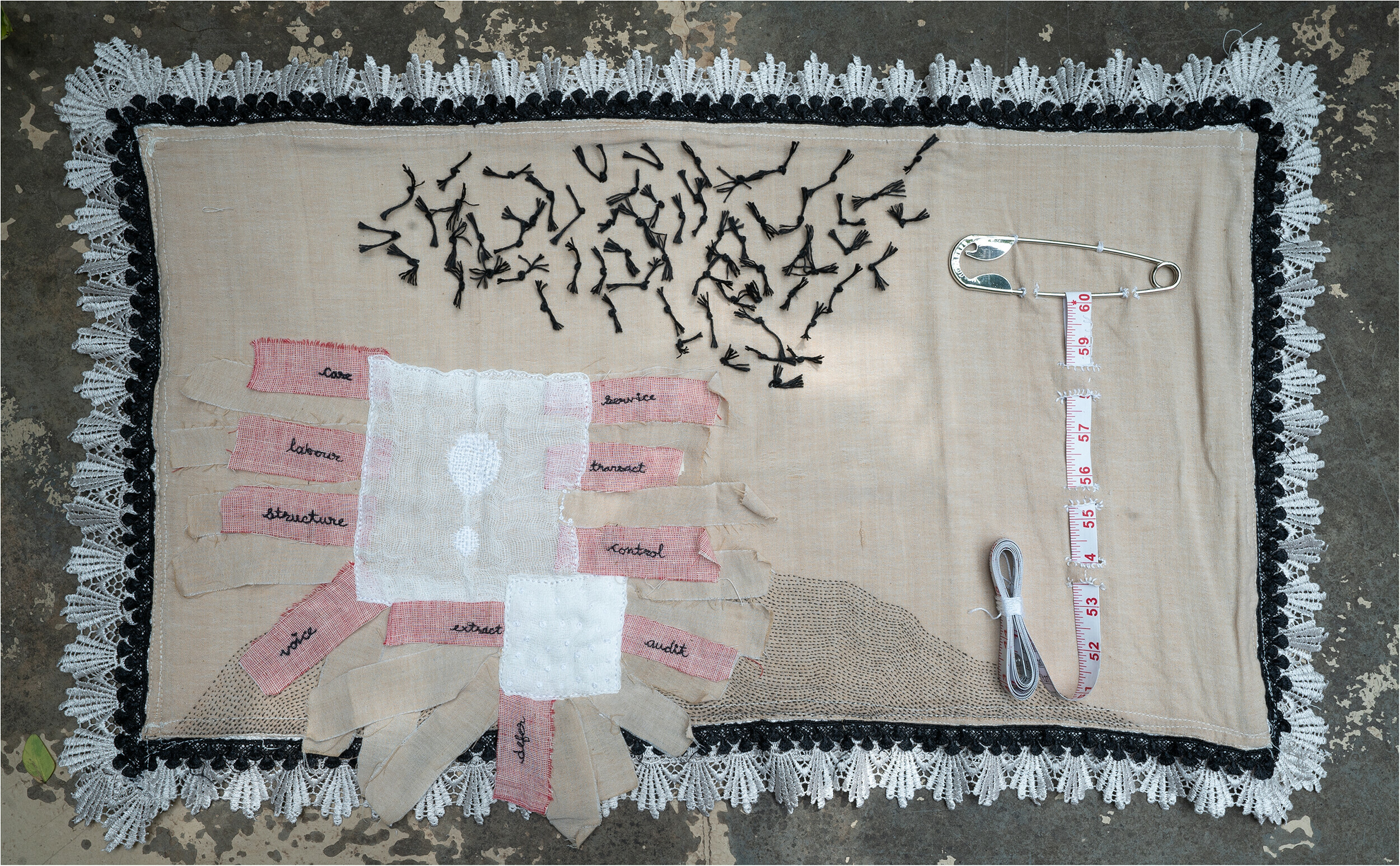 | | Rohini Sen 2026 Embroidery on Khadi, Gauze Bandage, Safety Pin, Measuring Tape, Machine made lace
The Prestidigitation of Care: Colonial Knots, Contemporary Wounds
Rohini Sen
The Prestidigitation of Care (2026) is an original artwork accompanied by an extended artist statement that critically examines the enactment and governance of care within neoliberal higher education institutions in India. Employing embroidery and drawing on repurposed khadi, bandage cloth, machine-made lace, measuring tape, and a safety pin, the work adopts material inquiry as a mode of practice-based research. The selected materials function as conceptual agents, evoking repair, labour, measurement, and institutional control. Together, they interrogate the material, affective, and political dimensions of care within audit-driven cultures of contemporary higher education.
Read the full article here | | Photo by Annie Vo on Unsplash
Introducing “Teaching Notes”
Nick Pendergrast and Garrity Hill
This editorial launches “Teaching Notes,” a new special section of the Journal of Sociology that aims to create a dialogue among sociology teachers, and share experiences and reflections on our practice. In this section, we publish both empirical research and reflective essays grounded in relevant literature that consider the issues most pressing in our classrooms now. The editorial also introduces Associate Editors, Dr. Garrity Hill and Dr. Nick Pendergrast, who teach sociology at the University of Melbourne, Australia. It outlines the purpose and remit of the section as a guide for future contributions.
Read the full article here |  | | Photo by Sal Clark
“It Turns Theories into Realities”: Student and Teacher Reflections on the Pedagogical Value of Short-term Mobility Programs and the Making of Global Citizens
Sal Clark, Afrika Roach, Miranda Ahearn-Chevers and Alessia Casella
This article investigates the pedagogical value of short-term international mobility programs, focusing on a 2024 sociological study tour to Indonesia. Using a dialogical autoethnographic approach that incorporates both student and teacher reflections, we examine how immersive study tours, often dismissed as academically shallow or exploitative, can foster transformative learning. Through cultural immersion, students are challenged to apply erstwhile theoretical concepts to practical situations, confront cultural differences, and develop critical soft skills such as intercultural competency and reflexivity. The findings reveal that well-structured short-term mobility programs can significantly enhance personal growth, professional development, and the development of critical global citizenship. The article concludes by outlining key pedagogical lessons arguing that when grounded in clear outcomes, reflexive assessment and ethical design, short-term mobility programs offer enduring personal, academic, and professional benefits for humanities students.
Read the full article here |  | | Photo by Gábor Jambrik via Pexels
Crip Embodiment as Resistance to the Neoliberal Academy
Ebony Muller
Disability disrupts ableist, neoliberal fantasies and demands for unlimited health and capacity. When the body can no longer will itself to neoliberal standards, people and environments must shift to make space for the crip, as the nature of their embodiment ‘leaks’ and spills out in the neoliberal workplace. Informed by a sociological understanding of the management and performance of bodies, this article utilises personal reflection on teaching and working in the academy to present a crip pedagogical manifesto in three parts: how disability embodiments and conceptions disrupt ableist ideals; how crip care can be a cannon for more intersectional forms of care; and the leaks of the author's own crip embodiment in the academy. Here, disability embodiment is presented as a generative, active site that strengthens ties to self and community care: a site of embodied and political resistance to the neoliberal academy.
Read the full article here |  | |