HomeTASA Prizes and Awards
To modify this page, paste in the URL of the banner image. Get the banner image URL from clicking the clipboard icon in web graphics manager. Search for images in the "banner" category.

To modify the links on the right hand side, right click on the link and select "change link" from the popup context menu. The link will automatically format to have the arrow.

You may also use a submenu widget here instead of manual links. The awards pages names were too long for the submenu widget - page names have a maximum character length of 26 characters.

To change the image in the gray row (beneath the text) right click on the image, and choose "change image" from the context menu.

All other text should be selected and retyped.
Image 1 URL //s3.amazonaws.com/ClubExpressClubFiles/671860/graphics/Katie_Hughes_and_Helen_Meekosha_485057101.jpg
Image 1 URL //s3.amazonaws.com/ClubExpressClubFiles/671860/graphics/Christy_Newman_and_Steven_Matthewman_785557220.jpg

TASA Prizes and Awards

TASA currently offers eleven major awards and prizes. Historical information on each one can be accessed from this page via the purple bars below. Due to pandemic related restrictions, our Awards Ceremony was conducted online, and recorded, in 2020 and 2021

For current details on each Award/Prize etc., please click on the orange button below:

Awards, Prizes, Scholarships & Bursaries

The Association also offers scholarships intended to support postgraduates, those working in applied sociology & those with accessibility requirements to participate at TASA’s annual conference.


Accordion Widget
Jean Martin Award
Jean Martin Award

The Jean Martin Award was established in 1980 and is granted bi- annually to the best PhD thesis in a social science discipline submitted to the Award Committee from an Australian tertiary institution. The inaugural recipient was Claire Williams, whose PhD was published as Open Cut by Allen and Unwin.

Claire Williams: Recipients of the inaugural Jean Martin Award


2021: Catriona Stevens
2019: Brydan Lenne
2017: Janine Pickering

2015: Benjamin Gook

2013: Xiaoying Sheila Qi

2011: Katherine Carroll

2009: Peter Nugus

2007: Belinda Hewitt

2005: Sarah Maddison

2003: Millsom S. Henry-Waring

2001: Dimitria Giorgas and S. Caroline Taylor (joint recipients)

1999: Adam Possamai

1997: Vera Ranki

1995: Supriya Singh

1993: Diana Olsberg

1991: Kerry Carrington

1989: Loucas Nicolaou

1987: Andrew Metcalfe

1985: Claudia Knapman

1982: Evan Willis

1980: Claire Williams


Accordion Widget
Best Paper in the Journal of Sociology Award

The Best Paper in the Journal of Sociology Award is given to a paper judged by the panel to be the best published in the previous year of the journal (moved to an annual prize in 2019); the inaugural recipient was Eric Livingstone in 1995.

Recipients

2022: Kanemasu, Y., & Liki, A. (2021). ‘Let fa’afafine shine like diamonds’: Balancing accommodation, negotiation and resistance in gender-nonconforming Samoans’ counter-hegemony. Journal of Sociology, 57(4), 806–824. https://doi.org/10.1177/1440783320964538. You can watch the authors' acceptance speech here.

2021: Prehn J, Guerzoni MA, Peacock H. ‘Learning her culture and growing up strong’: Aboriginal and/or Torres Strait Islander fathers, children and the sharing of culture. Journal of Sociology. 2021;57(3):595-611. doi:10.1177/1440783320934188

2020: Kidman J. Whither decolonisation? Indigenous scholars and the problem of inclusion in the neoliberal university. Journal of Sociology. 2020;56(2):247-262. doi:10.1177/1440783319835958


2019: Anna Anderson (2019). Parrhesia: Accounting for different contemporary relations between risk and politics. Journal of Sociology, 55(3), 495–510. 

2018: Michelle Peterie (2017) Docility and desert: Government discourses of compassion in Australia’s asylum seeker debate. Journal of Sociology, 53(2), 351–366.

2016: Roach Anleu, Sharyn and Kathy Mack (2015) ‘Performing Authority: Communicating Judicial Decisions in Lower Criminal Courts’ 51(4) Journal of Sociology 1052-1069.

2014: Gerard Delanty (2014) “The prospects of cosmopolitanism and the possibility of global justice”, Journal of Sociology. Vol 50 (2): 213-228.

2012: Andy Furlong, Dan Woodman and Johanna Wyn ‘Changing times, changing perspectives: Reconciling ‘transition’ and ‘cultural’ perspectives on youth and young adulthood’, Journal of Sociology 47:355.

2010: Brad West ‘Collective memory and crisis: the 2002 Bali bombing, national heroic archetypes and the counter-narrative of cosmopolitan nationalism’, Journal of Sociology.

2008: Amanda Hosking and Mark Western (2008) ‘The effects of non-standard employment on work—family conflict’ Journal of Sociology 44(1):5-27.

2006: Timothy Phillips and Philip Smith (2004) ‘Emotional and behavioral responses to everyday incivility: challenging the fear/avoidance paradigm’ Journal of Sociology 40(4):378-399.

2003: Ian Woodward ‘Divergent narratives in the imagining of the home amongst middle-class consumers: Aesthetics, comfort and the symbolic boundaries of self and home’, Journal of Sociology 39(4):391-412.

2001: Philip Smith and Tim Phillips ‘Popular understandings of “unAustralian”: an investigation of the un-national’, Journal of Sociology 37(4):323-339.

1999: Marion Collis ‘Marital conflict and men’s leisure: how women negotiate male power in a small mining community’, Journal of Sociology 35(1).

1997: Michael Emmison ‘Transformations of taste: Americanisation, generational change and Australian cultural consumption’, Australian and New Zealand Journal of Sociology 33(3).

1995: Eric Livingston ‘The idiosyncratic specificity of the methods of physical experimentation’, Australian and New Zealand Journal of Sociology, 31.


Accordion Widget
Best Paper in Health Sociology Review
The TASA Best Paper Award for Health Sociology Review (HSR) is a biennial process that uses academic peer review to reward papers of outstanding quality published in HSR. The prize is awarded to the paper judged by the panel to be the best of those published in the previous two years of Health Sociology Review

2021: Ángel R. Zapata-Moya, Barbara Willems & Piet Bracke (2019) The (re)production of health inequalities through the process of disseminating preventive innovationHealth Sociology Review, 28:2, 177-193, DOI: 10.1080/14461242.2019.1601027

2019: Natalia Luxardo & Hernán Manzelli (2017) Blurred logics behind frontline staff decision-making for cancer control in ArgentinaHealth Sociology Review, 26:3, 224-238. 

2017: Dew, K. (2016). Purifying and hybridising categories in healthcare decision-making: the clinic, the home and the mul. Health Sociology Review, 25(2), 142-156.


Accordion Widget
Early Career Researcher – Best Paper Prize
TASA Prize for the most distinguished peer-reviewed (MDP) article published by an Early Career Researcher
An annual award for the best authored sociological paper nominated for this Prize. Nominations for the 2019 TASA Prize for the most distinguished peer-reviewed article published by an Early Career Researcher closes June 30, 2019.

About the Prize

The TASA Prize for the most distinguished peer-reviewed article published by an Early Career Researcher is an annual process that uses academic peer review to select a paper of outstanding quality published in any journal during the previous three calendar years (ie the 2019 Award will assess papers that were published from 2016 – 2018). The Prize was established in 2016 to provide more opportunities for early career sociologists to gain recognition for the quality of their scholarship and enhance their reputations, especially within interdisciplinary teams.

The MDP Award is presented at the TASA annual conference.

Recipients:
2022: James, A & Whelan, A 2022. ‘Ethical’ Artificial Intelligence in the Welfare State: Discourse and Discrepancy in Australian Social Services. Critical Social Policy, 42 (1), 22-42. (Online first 11 January 2021)

2021: Clarke, Andrew, Cheshire, Lynda and Parsell, Cameron (2020). Bureaucratic encounters “after neoliberalism”: examining the supportive turn in social housing governance. The British Journal of Sociology, 71 (2) 1468-4446.12740, 253-268. doi: 10.1111/1468-4446.12740

2020: Farrugia, A., Fraser, S., Dwyer, R., Fomiatti, R., Neale, J., Dietze, P. and Strang, J. (2019). Take-home naloxone and the politics of care. Sociology of Health and Illness, 41 (2), 427-443.

2019: Emma Lee - Lee, E. (2017) Performing colonisation: The manufacture of Black female bodies in tourism researchAnnals of Tourism Research. Volume 66, September 2017, Pages 95-104

2018: Karla Elliott - Elliott, Karla (2016), ‘Caring masculinities: theorizing an emerging concept’, Men
and Masculinities
, vol. 19, no. 3, pp. 240-259.

2017: Juliet Watson - Juliet Watson (2016). Gender-based violence and young homeless women: femininity, embodiment and vicarious physical capital. The Sociological Review

Inaugural winner - 2016: Jennifer Cheng

Cheng, J. (2015), ‘Islamophobia, Muslimophobia or racism? : parliamentary discourses on Islam and Muslims in debates on the minaret ban in Switzerland’, Discourse and Society, vol 26, no 5 , pp 562 – 586.

Accordion Widget
Distinguished Service to Australian Sociology Award

In 1996, the Association introduced the Distinguished Service to Australian Sociology Award, and its inaugural recipients were Lois Bryson and John Western.


Recipients of the Distinguished Service to Australian Sociology Award:

2022: Sharyn Roach Anleu

2020: Roberta Julian

2018: David Rowe

2017: Johanna Wyn

2014: Emirtus Professor Riaz Hassan

2013: Professor Evan Willis acceptance speech &  Emeritus Professor Gary Bouma acceptance speech

2007: Raewyn Connell

2004: Katy Richmond

2000: Cora Baldock

1996: Lois Bryson and John Western.


Accordion Widget
Stephen Crook Memorial Prize

The Stephen Crook Memorial Prize was established in 2003 and is given bi-annually to the best authored monograph in the discipline of Sociology published by an Australian sociologist; the inaugural recipient was Michael Pusey.


Recipients of the Stephen Crook Memorial Prize:

2022: Xiaoying Qi - Remaking Families in Contemporary China

2020: Nicholas Hookway - Everyday Moralities: Doing it Ourselves in an Age of Uncertainty

2018: Alan Petersen, Megan Munsie, Claire Tanner, Casimir MacGregor and Jane Brophy – Stem Cell Tourism and the Political Economy of Hope. Palgrave Macmillan.

2016: Joel Windle – Making Sense of School Choice: Politics, Policies, and Practice Under Conditions of Cultural Diversity. Palgrave Macmillan. 2015.


2014: Fran Collyer – Mapping the Sociology of Health and Medicine: America, Britain and Australia Compared. Houndmills, Basingstoke: Palgrave Macmillan (2012).


2012: Rob White – Transnational Environmental Crime: Toward an Eco-global Criminology. Routledge: Willan 2011.


2010: Jack Barbalet – Weber, Passion and Profits: ‘The Protestant Ethic and the Spirit of Capitalism’ in Context. Cambridge: Cambridge University Press 2008.


2008: Raewyn Connell – Southern Theory: The Global Dynamics of Knowledge in Social Science. Allen and Unwin 2007.


2005: Jan Pakulski – Globalising Inequalities: New Patterns of Social Privilege and Disadvantage. Allen and Unwin 2005.


2003: Michael Pusey – The Experience of Middle Australia: The Dark Side of Economic Reform. Cambridge University Press 2003.


Accordion Widget
Raewyn Connell Prize

In 2010, the Raewyn Connell Prize was established and is awarded biannually to the best authored, first monograph within the discipline of Sociology. The first recipient was Peter Robinson for his book The Changing World of Gay Men.

Recipients of the Raewyn Connell Prize:

2022: Leah Williams Veazy - Migrant Mothers in the Digital Age

2020: Steven Threadgold - Youth, Class and Everyday Struggles

2018: Natalie Jovanovski – Digesting Femininities. Palgrave Macmillan


2014: Shanthi Robertson – Transnational Student-Migrants and the State. Palgrave Macmillan(2013).

2012: Catherine Robinson – Beside One’s Self: Homelessness Felt and Lived. Syracuse University Press 2011.

2010: Peter Robinson – The Changing World of Gay Men. Basingstoke, Palgrave Macmillan 2008.


Accordion Widget
Outstanding Service to TASA Award

2010 also marked the year of the inauguration of the Outstanding Service to TASA Award, given to a TASA member who has demonstrated an outstanding level of participation in and promotion of TASA over a number of years; the inaugural recipient was John Germov.

Recipients of the Outstanding Service to TASA Award

2014: Sharyn Roach Anleu

2013: Eileen Clark

2010: John Germov


Accordion Widget
Teaching Sociology Award

This award, first offered in 2015, celebrates outstanding contributions to enhancing the pedagogy, practice or outcomes of teaching and learning sociology in Australia. It recognises contributions at the disciplinary level (rather than acknowledging excellence in teaching within the classroom or institutions). Examples of disciplinary-level contributions include innovations in teaching that increase the impact of sociology teaching beyond university contexts, improve student access, experience and outcomes, or inform disciplinary approaches to learning and teaching Evidence of these achievements may be demonstrated through feedback from students or peers, and/or through publications (peer-reviewed, policy or general), presentations, media, or other relevant indicators.

In this context, outstanding contributions to the teaching of sociology may be made within or beyond teaching activities in universities.

Nominations for the award will be judged against the criterion of significant impact on teaching within the discipline of sociology.

Process

No more than one Award will be made each year, unless there are unusual and compelling reasons to make two Awards. The award may be granted to a single nominee or to a team. All nominees must be TASA members.

It is not necessary to make an Award every year, and it is to be expected that there may be years when an Award is not made.

The Award will comprise an engraved trophy and certificate. Recipients will be invited to write an opinion piece about some aspect of their work for publication in Nexus, TASA Blog, Journal of Sociology or any other publication TASA may sponsor at the time of the Award. A list of Award winners will be maintained on the TASA web site.

The Executive will call for nominations each year, with nominations closing June 15. The Award will be presented at the TASA Conference in the same year. This time schedule may be altered in any year at the discretion of the Executive. Recipients shall be offered the same assistance as other TASA prize winners to enable them to attend the prize presentation.

The written nomination must respond to the criterion in no more than 1000 words and must be accompanied by a two-page (maximum) curriculum vitae of the nominee. The CV should focus on work and outputs related to the nomination. Applicants may submit other materials (ie multimedia) with their nomination form. The nomination form must be signed and supported by two TASA members.

Nominations will be considered by the Executive as a whole. At its discretion the Executive may assign this task to a sub-committee chaired by the President or Vice-President, with the decision to be ratified by the whole Executive.

The Teaching Excellence Award process will be covered by the TASA grievance procedures. Apart from this, the Executive’s decision is final and no correspondence will be entered into.

Recipients

2020
No nominations were received.

2019
No nominations were received.
2018

No nominations were received.

2017

No nominations were received.

2016

No nominations were received.

2015

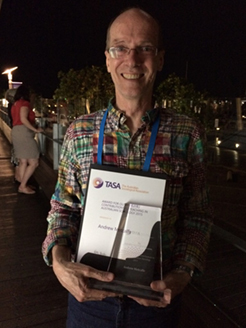
Inaugural Recipient
Andrew Metcalfe

Accordion Widget
TASA Sociology in Action Award
This award recognizes contributions to the practice of sociology outside of academic settings. It is conferred on a TASA member who has made an outstanding contribution to sociological practice in Australia.


In this context, outstanding contributions to sociology in action highlight the value and impact of sociological methods and theories to society. This includes both broad social issues, as well as more focused issues for industry, government, business or community sectors.


Nominations for the award will be judged against the following criteria:

  • The application of sociology knowledge, methods and expertise to contribute to solving social problems
  • The applicant’s role in the use of sociology for addressing social issues
  • Recognised impact on a practical sociological problem, whether broad or focused in nature. Impact may be demonstrated through references from relevant stakeholders, and/or presentations, media, and publications (peer-reviewed, policy and general).

Process

No more than one Award will be made each year, unless there are unusual and compelling reasons to make two Awards. The award may be granted to a single nominee or to a team. All nominees must be TASA members.


It is not necessary to make an Award every year, and it is to be expected that there may be years when an Award is not made.


The Award will comprise an engraved plaque and certificate, complimentary conference and dinner registration to attend the TASA conference in the year of the Award (this is not transferrable to future conferences). Recipients will be invited to write an opinion piece about some aspect of their work for publication in Nexus, TASA Blog, Journal of Sociology or any other publication TASA may sponsor at the time of the Award. A list of Award winners will be maintained on the TASA web site.


The Executive will call for nominations each year, with nominations closing June 15. The Award will be presented at the TASA Conference in the same year. This time schedule may be altered in any year at the discretion of the Executive. Recipients shall be offered the same assistance as other TASA prize winners to enable them to attend the prize presentation.


The written nomination must respond to the criteria in no more than 1000 words and must be accompanied by a two-page (maximum) curriculum vitae of the nominee. The CV should focus on work and outputs related to the nomination. Applicants may submit other materials (ie multimedia) with their nomination form. The nomination must be signed and supported by two TASA members and accompanied by a written reference from someone outside the applicant’s organisation who can comment on the impact and relevance of the applicant’s contribution.


Nominations will be considered by the Executive as a whole. At its discretion the Executive may assign this task to a sub-committee chaired by the President or Vice-President, with the decision to be ratified by the whole Executive.


The Sociology in Action Award process will be covered by the TASA grievance procedures. Apart from this, the Executive’s decision is final and no correspondence will be entered into.

his is some placeholder content. Select/Highlight and simply type over or press delete to replace. Insert images, text or whatever you'd like.

2022: Sophie Hickey

2020: Peta Cook

2019 Recipient: Katherine Carroll (L) with 2019 JMA winner Brydan Lenne (Katherine was one of Brydan's supervisors).


2018 Recipient: Catherine Robinson


2016 Recipient: Yoland Wadsworth


2015 Inaugural Recipient: Alan Scott


Accordion Widget
Postgraduate Impact & Engagement Award
This annual award recognises the impact and engagement of a Postgraduate TASA member’s scholarship that is of high social value to Australian society and/or sociology. We invite TASA Postgraduate members to submit an application (or nominate others) for outstanding impact or engagement with sociological scholarship.

2022: Hyein Cho (Ellen)

2021: Erik Denison

There were two inaugural recipients in 2020:

Osmond Chiu & Brittany Ralph


Catherine Chris and Josheph
(from left) Catherine Robinson, Chris Brown (2018 recipient of the Sociology in Action scholarship) and Joseph Borlagdan.


TASA History