Cora Baldock was born on 16 December 1935 in Rotterdam, as Corrie Vellekoop, the youngest of three children. Her father, Cornelis Vellekoop, also born in Rotterdam, worked his entire life for the Norwegian Consulate in that city. His job meant that Corrie as a young girl frequently met Norwegian people, who usually communicated in English –providing her with some early fluency in that language. Her mother, Maartje Johanna Poldervaart, was born in Hellevoetsluis as the eldest daughter of a sea pilot. It was when Corrie’s maternal grandfather gained a position as sea pilot with the Dutch-America line in Rotterdam and rented an apartment from the Vellekoop family, that her parents met and married.
Corrie had her first serious attack of asthma when she was six months old. This condition was one of the three formative influences on what she likes to describe as her “breath-taking” life. It limited her in many ways, but at the same time gave her opportunities that were not available to her sister and brother. The outbreak of World War II was a second significant factor. Whilst her parents and siblings experienced the bombing of Rotterdam, Corrie was absent – at the age of four visiting her mother’s sister and brother-in-law, Aunt Jo and Uncle Wim. Mysterious consultations between her mother and Corrie’s asthma specialist led to a joint family decision, that Corrie would remain with her aunt and uncle. Family folklore has it that the doctor suggested asthmatic children were better off away from their mothers (as they would cling too much). Apparently, such advice was not unusual at the time, but the chaos of early war and possibly also pressures placed on Corrie’s mother, having to care for three very young children, one of them chronically ill, may well have been other reasons. Whatever the circumstances, the decision was momentous for Corrie because it meant that her formative years (specifically the war years) were spent in the company of highly intellectual, academic-minded surrogate parents, who had a powerful influence on her life choices. The death of Corrie’s brother Jan in 1950, at age 15, was the third and very sad influence on her development. His demise brought about the financial resources (previously set aside for the future of this only son) for Corrie’s university education. Her aunt and uncle had always maintained that she should go to university; that it would become Leiden University and sociology, was also due to their influence.
In some sense it could be said that the rest is history. Corrie (having changed her name to Cock) did extremely well at university, soon no longer needing her parents’ financial support because she became a part-time tutor and research assistant even whilst still an undergraduate. Cock was a third-year student and secretary of the student sociology faculty when Queen Beatrix, then a princess, arrived in Leiden to study sociology. It was Cora’s responsibility to provide her with introductory information about sociology, and briefly act as a kind of mentor. A photo taking at the time illustrates this. Cock completed a cum laude doctorandus degree in sociology in record time, afterwards adding a bachelor’s degree in history (also cum laude), while starting her first academic job at Leiden University. Altogether she lived, studied and worked in Leiden for ten years.
However, a certain restlessness, and an interest in all things English, led to her decision in 1964 (as Cora Vellekoop – again a subtle name change) to move to an academic position at Canterbury University in Christchurch, New Zealand. There she stayed for six years, teaching sociology and completing a part-time PhD, published in 1971 under the title Vocational Choice and Opportunity. This was followed by two years of academic teaching at San Diego State College, in San Diego, California and three years at Bernard Baruch College, City University of New York in a similar capacity. By that time another major name change had occurred, to Cora Vellekoop Baldock; this was after her marriage to David Baldock, whom she had met and married in New Zealand in 1970. In late 1974 she ‘migrated’ from New York to Canberra, Australia with her then husband David and her two young children, Lee and Karen, born in Manhattan, New York in 1972 and 1974 respectively. Her first academic job in Australia was at the Australian National University, a position she held for three years. The family then moved to Perth and Cora to a senior lectureship at Murdoch University, where she remained for 22 years until her retirement as full Professor in 2001, by that time (at age 65) having completed an overall, uninterrupted, academic career of 40 years.
Her accomplishments as an academic, apart from the training of large numbers of students, including supervision of Honours and PhD students, were first of all in the writing on a handful of books and numerous book chapters and articles in the sociology of paid and unpaid work, the history of sociology in Australia and New Zealand, family and social welfare policy, and most recently transnational care-giving between migrants and their families ‘back home’. Her books include: Sociology and Social Change Theory (1972); Sociology in Australia and New Zealand (1974, with Jim Lally); Women, Social Welfare and the State (1983 with Bettina Cass); Volunteers in Social Welfare (1990) and Families Caring Across Borders (2006/2007 with Loretta Baldassar and Raelene Wilding). Cora also played a major part as a university administrator in university committees dealing with academic promotions, research grant allocations, and equal opportunity for academic women. In the late 1970s she was President of the Australian Sociological Association; in the 1980s a member of the Australian Research Grants Committee, and in the 1990s a member of the Federal Government’s Multicultural Advisory Committee. At her retirement Murdoch University bestowed an Honorary Degree on her for her services to the University. As an Emeritus Professor she continues to research and write, while also pursuing leisure time interests in Mah Jong, reading, music, travel (mainly back to the Netherlands to visit her married daughter) and socializing with friends and her married son’s family in Perth, the latter now in the capacity of grandmother. Cora remains a fluent speaker and writer of the Dutch language, has published a few academic articles in Dutch and maintains some ongoing contacts with sociology colleagues in the Netherlands, New Zealand, San Diego, and New York.
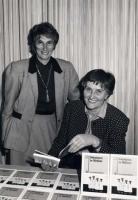 Monday, August 28, 2006: Cora Baldock at the launch of her book, Volunteers in Welfare (Allen and Unwin Sydney 1990) by Professor Fay Gale, (Vice Chancellor UWA) Murdoch University.
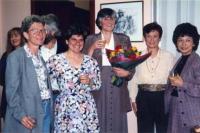 Celebration party when Cora Baldock received her personal chair in Sociology at Murdoch University 20 August 1993. Colleagues, on Cora’s right: Dr Liz Harman, Veronica Sim (sec), on her left: Yolie Masnada (sec) further left Dr Jim McBeth, and Emeritus Professor Patricia Harris.
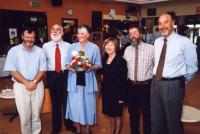 Retirement party at Murdoch December 2000. Colleagues on Cora’s left: Professor Geoffrey Bolton,Theology Professor; on her right: Professor Bill Loader, Professor Kateryna Longley, Dr Mike Campion, Sociology and Vice-Chancellor Professor Steven Schwartz.
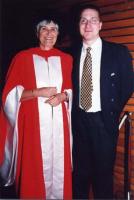 Honorary degree ceremony (Doctor of the University, Murdoch University) with son Lee Baldock, 2001.
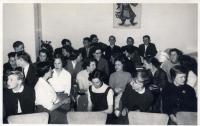 Cora Baldock (3rd row from front, 4th from left) next to HRH Princess Beatrix now Queen of the Netherlands (3rd from left). Meeting of Sociology Faculty Student Organisation at University of Leiden, 1957.